

Esin's Turkish Green Beans in Olive Oil (Taze Fasulye)
My mother-in-law's recipe for a beloved Turkish classic

Hi, I’m so glad you’ve stopped by. I’m Leslie, an enthusiastic cook and vagabond who loves making homecooked dishes from around the world.
If you enjoy this post, it would mean so much to me if you’d subscribe and click the ❤️ button at the bottom of the post. I read and respond to all comments, so if you have any thoughts or feedback, I’d love to know!
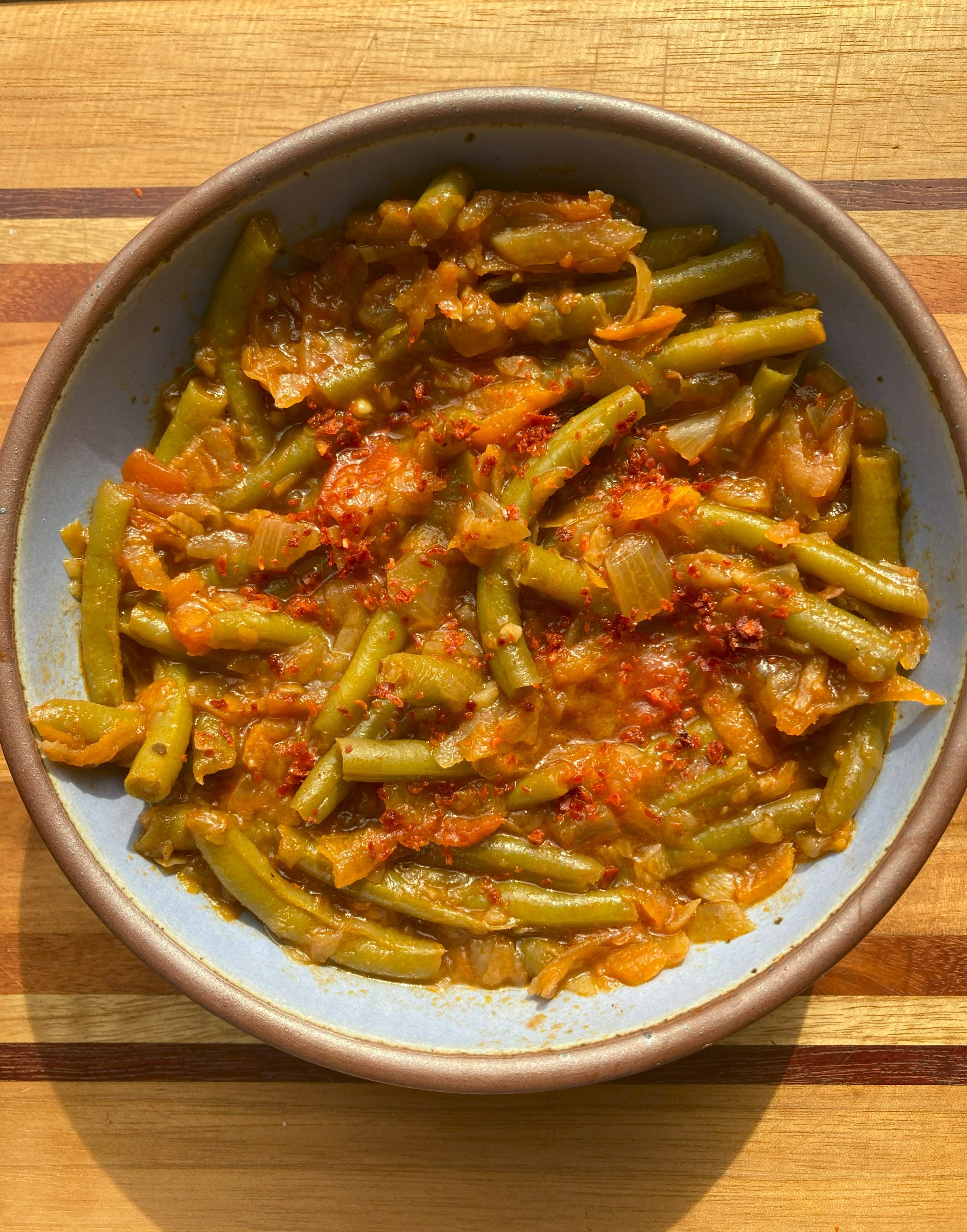
I grew up in a house where tender crisp vegetables were the gold standard.
One of my mom’s unspoken mottos was, “al dente, or bust.”
The first time Bulut offered me taze fasulye in 2018, he introduced it as “just green beans cooked with tomato until they’re really soft. It’s great!”
I stared at him blankly and said “I don’t know. I’ll try a bite if you get it.”
It was the best response I could muster without saying “Ew, that sounds like overcooked mush.”
My mom’s words crept from the back of my head toward my frontal lobe, and I started panicking a little. I didn’t want to offend my boyfriend during my first trip to his home country, but I also didn’t want to abandon my standards of quality and taste.
Good thing that my mom also conditioned me to try anything at least once.
I looked at the pale, drab green beans and prepared myself to be disgusted.
But then, something strange happened. Instead of a mushy green-tasting (yes, things can taste like colors) watery vegetable, I experienced a mouthful of melt-in-my-mouth, slightly umami tomatoey green beans. They were even buttery.
My mind slightly broke.
All my life, I was told that “overcooked” vegetables were gross, only to realize I had never tried such a thing. And through my own tastebuds, I was experiencing that this “law” of food was a fallacy.
What else did I not know about?!
I was both shocked and excited to learn that there is a whole category of Turkish dishes like this — simmered into delicious oblivion with olive oil and often tomato — called zeytinyağlılar, literally “the things with olive oil”. Taze fasulye is one of the most popular and universally well-liked of these dishes. I sought to try as many as I could throughout the remainder of the trip.
Since then, I’ve been trying to make taze fasulye at home in the US. But, unfortunately, I could never get it right.
I often couldn’t find flat green beans in the US, so I used haricots verts instead. My tomato-to-green bean ratio was almost always off. The dish didn’t have the same buttery mouthfeel that I experienced in Türkiye. And the final product was always too watery, nothing like the unctuous green beans that initially wooed me.
I kept trying, kept failing, kept researching and trying again. I just chalked it up to not having the “right” ingredients in the US.
Then, in 2024, Bulut’s mom came to the US for our wedding. One night, we needed to run an errand and she offered to cook for us. I really hate to let a guest to cook for us, but I knew that Bulut’s mom’s offer was sincere and that cooking for others is one of her love languages. We also happened to have the ingredients for taze fasulye on hand, so at this point, it would have been rude to turn down her offer.
When we returned from our errand, we were greeted by, dare I say, the best taze fasulye I had ever tasted.
We asked her to explain what she did, and she was like “Oh, nothing, I just grated in some potato and carrot with the onion and cooked it until it was done.”
“Cook until done” are common words in most explanations of Turkish cooking that I will always laugh at and be mad at simultaneously.
I had never read any recipe that included potato and carrot, but it was genius— the sweetness of the carrot and the starch of the potato added more flavor and textural dimension to the dish. I rushed to inspect the bottle of olive oil and jar of tomato paste to see how much she had used. Yes, I do keep some mental track of how much is remaining of my staples, and it was finally serving a purpose!
I felt giddy with renewed hope of being able to make this dish in the US, and all with ingredients from Trader Joe’s at that! (not sponsored :))
Also, is it weird that this is a core memory of my wedding week? Don’t answer that. I love that it is.
I am excited to finally be able to share this recipe with you!
Taze fasulye can be enjoyed as a main or as a side. As a main, I love to pair it with rice and plain yogurt, but it’s not compulsory.
Did I mention how easy it is to prepare? It takes just 20 minutes of hands-on time. The hardest part is waiting for it to simmer because the smell is so inviting, and I get impatient for it to ready!
Traditionally, this dish is made in the morning, left in the pot on the (turned off) stove all day, and then enjoyed for dinner. Turks feel that the flavors are better after it sits out. Given that taze fasulye is naturally plant-based, it has less chance of going bad, but of course, do what you feel comfortable with. If you want to eat it right away, it’s still delicious. Yet, I agree with the opinion that it gets better with time. It also reheats beautifully from the fridge and makes for wonderful leftovers or meal prep.
If you make it, then ellerine sağlık, which means “Health to your hands.” This Turkish phrase is bestowed upon the chef for making wonderful food. And not to brag, but if you follow this recipe, I know it will be wonderful!
Special thanks to my mother-in-law for sharing her inherent Turkish cooking wisdom (and not realizing how special it is 😄).
As always, I’d love to know your thoughts below! What’s your opinion on well done vegetables? And have you ever had taze fasulye? 🙂
Taze Fasulye
Servings: 4-5 as a main, or 8-9 as a side | Time: 1 hour
Ingredients
4-5 tablespoons olive oil (though as Bulut says, there is no such thing as too much olive oil) *see Note 1
1 medium yellow onion, diced small
3 cloves of garlic, minced
1 medium carrot, grated (~a heaping cup)
1 medium yellow or gold potato, grated (~a heaping cup)
Russet would likely work, too
3 tablespoons tomato paste *see Note 1
2 medium tomatoes, diced small or grated
If tomatoes are not in season or your tomatoes are pale, add another half tablespoon of tomato paste, in addition to the tomatoes.
1-2 teaspoons kosher salt
1 lb haricots verts (or any fine, thin green bean) - fresh or frozen, broken into pieces no longer than 2 inches each *see Note 2
Optional: 1-2 teaspoons sugar
Hot water
Optional: Aleppo pepper, for topping
Method
Add 4 tablespoons of olive oil to a Dutch oven, or similar sized pot, over medium heat. When hot, add the onion and cook for ~5 minutes, until translucent. Turn down heat if it starts to brown at all.
Add garlic, carrot, and potato, and sauté, frequently mixing, for ~5 minutes until somewhat broken down. If it looks dry, add another tablespoon of olive oil.
Add tomato paste and mix. Cook for a few minutes, until it becomes a darker red and is fully incorporated into the vegetables. Add tomato and 1 or 1.5 teaspoons salt. Cook for a few minutes until tomatoes are broken down, scraping the bottom of the pan to ensure that nothing is stuck.
Finally, add green beans and sugar, if using, and mix them in. Let them cook for a few minutes and then add enough hot water to barely cover everything. Bring to a boil and then turn down to a simmer. Simmer for ~40 minutes, until very soft and tender. Check on them every 10 minutes or so, to ensure that the green beans are cooking evenly. Taste for salt and adjust as needed.
The liquid should be slightly viscous at the end. If it looks very watery, cook with the lid off for a few minutes to let some liquid evaporate.
This dish can be enjoyed hot or cold. I often like to serve it with a side of rice and yogurt. As usual, I sprinkle Aleppo pepper on top. 😁 It reheats beautifully in the microwave or on the stovetop.
Afiyet olsun! 🙂
Notes
(1) Quality of ingredients: In any dish with few ingredients, it’s imperative to choose good quality ones. Here, tomato paste and olive oil are the main flavoring agents so I implore you to choose decent ones.
There is no need to choose an expensive bottle of finishing olive oil. But if you can, use a cooking olive oil with a robust flavor.
Tomato paste in Türkiye is made with sun-dried tomatoes and has a very rich flavor. Therefore, I recommend using either a double concentrated tomato paste (usually the kind you find in squeezable tubes), or a good quality canned one like Trader Joe’s or Cento. (Not sponsored.) These are tomato pastes that I’ve tried and can vouch for.
(2) Green bean variety: Traditionally, this dish is made with a flat green bean known as Roma beans or Italian flat green beans. If you can find those, you may use them. You’ll just have to cut off the tips, de-string them, cut them length wise, and then crosswise so that you have somewhat thin pieces that are about 2 inches long. See this video for reference.
If you want to use a different green bean for this, proceed at your own risk. I have found that some tend to be more fibrous and don’t cook down well. Be sure to cook them for longer if needed, until they are very soft and tender.
Thank you for the restack, Lily! 🙂❤️